Homeschool Report Card: Math
March 31, 2010
Celine just recently completed Gamma level of Math U See so I thought I'd celebrate by sharing how we teach our children math. Woo-hoo, big party.
A series of homeschool posts coming your way
After talking about math I plan follow up with a few more posts to explain how we help our children learn "the academic basics" during their early homeschooling years. So far I have history/geography, writing and reading planned in addition to this post on math.
{Post Script: you can read those posts here - Studying the World Through Reading and Creative Play and Learning to Read Part One & Part Two.}
I consider these subjects to be the academic core. Not to say they are more important than others, they are not (except for maybe reading). And in terms of actual time spent studying something we spend more time learning about the outdoors than we do studying math for example. But these are the subjects that new homeschoolers or those considering homeschooling wonder "how do I teach (fill-in-the-blank) to my young child".
You'll notice science is missing from my list. I don't think I have time to address that anytime soon so I didn't want to make any commitments. I also don't see science as a foundational area of study during the early years.
Not to say we don't study science. We do. You can read examples of our science studies here and here. I just don't spend time planning how to study science, it simply happens in every day life and my husband also does a lot of inspirational science related activities in the evenings with the kids. The other subjects however I do spend time planning for and as such have given them more thought.
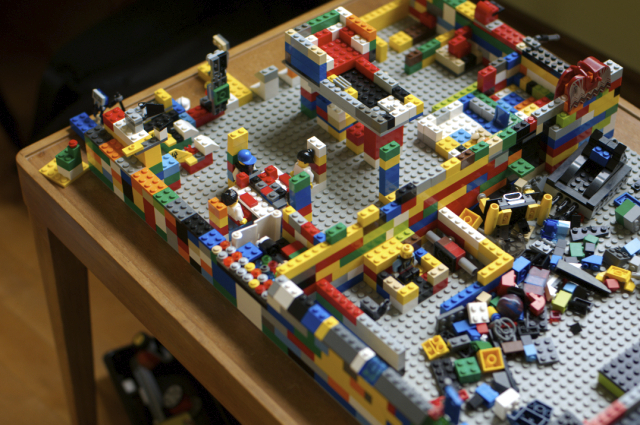
Lego: a beautiful marriage of science, math and fun
How we study math
I'd like to jump into this without re-iterating my whole educational philosophy which you can read about here, here and here. But I will say this, I believe it's totally possible to learn math in a completely "natural" setting, sans worksheets, workbooks and practice problems. I just don't have the mental energy to invest in that method. That requires more "here kids, let's measure the area of this garden plot" than I am able to accomplish.
I like following a (somewhat) structured program that holds my hand so I can make sure we're progressing in a logical order. My goal in these early years is to lay a foundation of basic principles so that I can say "hey Celine let's figure out how much fabric you need for that sewing project" and she can do that without me having to teach all the concepts on the spot and by the time I get around to explaining area she's no longer interested in the sewing project!
A curriculum
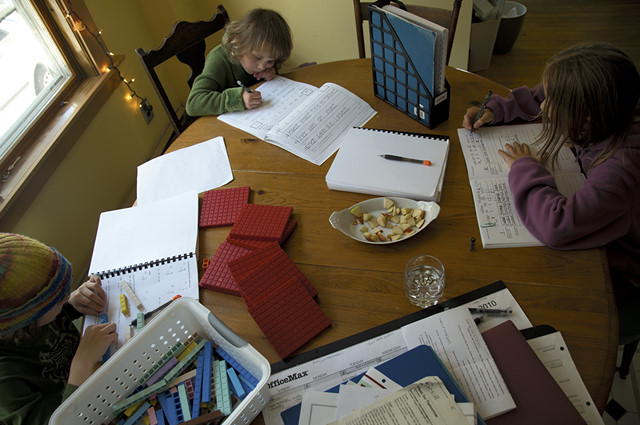
So far our family has had success with the Math U See curriculum. We all "get" the blocks, they make a lot of sense for us and the progression of concepts suits us well also.
Having said that I don't follow it exactly. We didn't start practicing math this way until Celine was 8 years old and even then I took it very easy. I have a take it slow approach to introducing structured lessons to young children but even so the younger two have picked up a lot by listening to their older sister's learning.
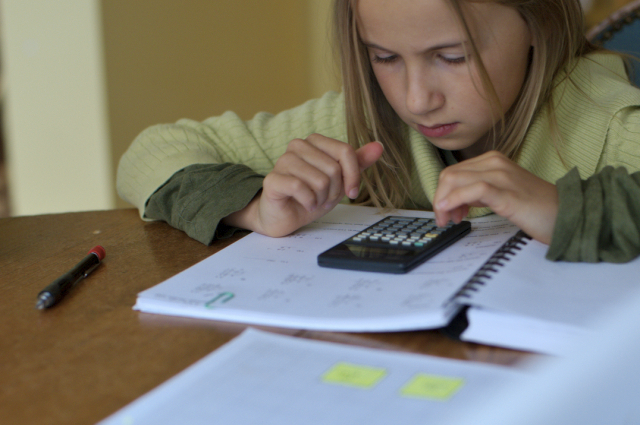
Celine checks her work with a calculator
It was Celine's request for more math that got me started down this path originally. As the oldest she is our guinea pig in everything. When she was younger I honestly hadn't given much thought to how or when I'd formally teach math to the kiddos. But I did scrupulously write down all the math learning we did do and capitalized on those teachable moments. Then around the time she turned 8 she requested more math so I figured the time was right to use structured lessons.
The other two have not had such a privilege of saying "I want to learn more math". I figure if I'm sitting down at the table while Celine does her math (we usually all sit at the dining room table together for "schoolish" acitivites) the other two can start, at an appropriate age and readiness, to join us for a few minutes (literally) of stuctured learning.

This is the story for each of our children:
- Celine, almost 11, is finishing up the Gamma level which I think is roughly grade 4 math?? I honestly don't know. It's basically everything to do with multiplication and a lot of measurements. We've been working on this particular book for almost a year and a half mostly due to a very long summer break last year (Is 4 months still considered summer break or spring & summer break?). She really gets math concepts and although she doesn't like learning new things (she wants to understand something without having to learn it first - don't we all) she overall doesn't mind the 30 minutes she spends 3 days a week working on it.
- Laurent, just turned 9, is working on Alpha which is grade 1/2?? Again, no clue. This is basic addition and subtraction. This isn't the first level in the curriculum, which is Primer, but he knew that stuff anyway so we just jumped into this level. Laurent does not like sitting for 15 minutes 3 times a week to do math. Or I should say he doesn't like it initially. With him, any interruption in his plans is met with discouragement, but not for long. He's an easy going kid so after 2 problems he's right into it. "Oh, this is easy" is a common refrain to hear from him.
- Brienne is 7 years old and hasn't started any curriculum math. Anytime she wants to join us she is free to do so and will from time to time do worksheets like a mad woman "more problems mama please". But her days of math freedom are coming to an end. After our April break she will start Alpha also and I suspect she is nearly at Laurent's level from sitting along side us as we've done the math together. She's ready for this even though she is feigning mortication at being required to sit down for a couple days a week to practice math.
A seasonal break
One thing that Celine and I have discovered is that long breaks from weekly math stimulation, ie: 4 months of spring/summer break, are too long. It's very difficult after this to bring your brain back to where you were at. So this season we're trying something new. We'll take a break for April, resume again in May and then take short summer breaks as needed but not longer than one month and we might even continue with weekly math practice right through a summer break. An hour or so per week is really not much.
The younger two will have more breaks this summer than Celine, she's at a different learning level and can handle the responsibility for her own math. But I've learned from experience that we won't stop for 4 months.
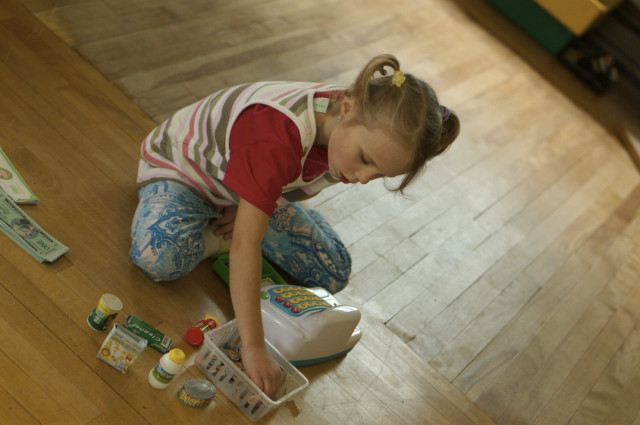
Brienne's store play with money
Everyday Math
We use the curriculum to assist our children in everyday math. The goal at this age is to understand life math and lay a foundation for further learning, not simply progress through a set curriculum. I want Celine to learn multiplication and measurements because you need those skills to be a good seamstress, something she is and she values.
We see math practice as giving our kiddos the skills they need to reach their goals. Though we roughly follow a curriculum we try to tie their math practice as much as possible to their everyday life and interests.
I won't go into all the ways we do that. There's too many to name. The kids do some kind of math each day, even if it's as simple as helping with meal prep measurements.
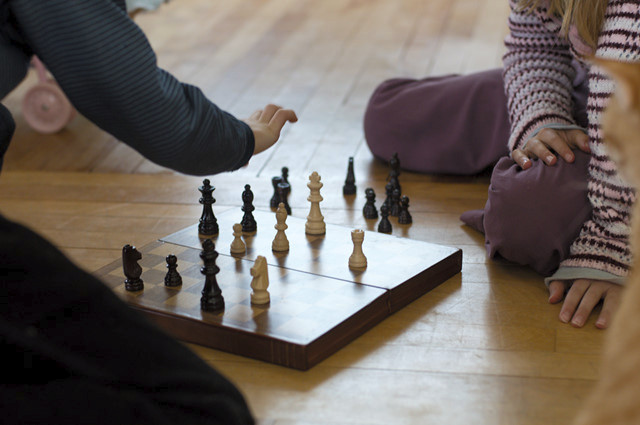
But I did want to mention a few games we like for simple enjoyment (that teach math skills also). We love card games, both regular deck and speciality cards. Racko is fun though I still have to partner with Brienne to help with ordering. Battleship is a favorite. The kids love chess (all of them play it) though I can't stand it. Dominos is great for teaching basic counting and numbers. Of course Lego is the perennial favorite and our math blocks also get used for building.
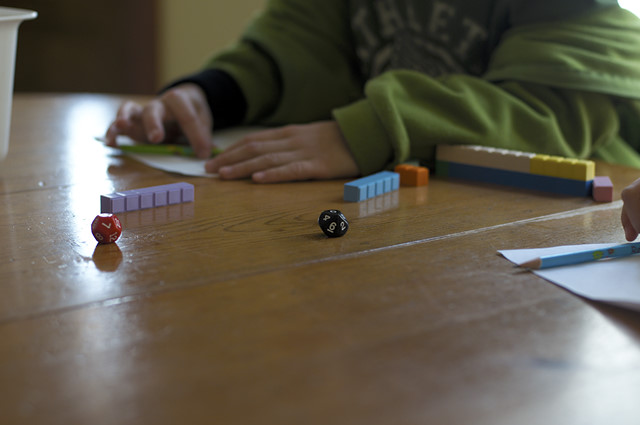
Recently we bought a mixed set of polyhedra dice and have had fun playing with those. Here's a great mixed level math game: Choose two different die. Roll die and have each player do a different computation with those numbers depending on their skill level. When we play Brienne has to add the numbers, Laurent subtracts and Celine multiplies. The kids play for the sheer fun of getting the correct answer, we don't compete though you could (and Brienne would probably prefer that).
Math Attitudes
I have to say initially I thought I was selling out on my ideals of relaxed interest-led learning by following a curriculum, however loosely, for math. But the reason we choose to do this was to help our children reach their goals, both short and long term.
There is nothing contrived about this and in actuality it is very relaxed and interest-led. The goal isn't to complete the curriculum, the goal is to move forward at whatever pace they are able to acquire skills needed for day-to-day living.
I think this is one reason there is no math anxiety in our home. Math isn't something you dread doing (unless it's taxes), it's just another part of life, like cooking the evening meal. Not to say there isn't frustration in the process. Sometimes there is and coming through that leads to a sense of accomplishment but there are no "math dummies" in our homeschool or "kids that just don't get it".
I've never heard the phrase "I'm no good at math" come from my children's lips. Math is interesting (the logic itself is a form of beauty), it helps us solve problems and reach our goals.
I think it's safe to say we like doing math and that the attitudes the kids are forming about math are more important than number of correct problems on a page or how fast they complete the unit.
Further Reading:
Just have to add this last note. I am a huge fan of David Albert's homeschool writing. This is a great essay (humorous and encouraging) about teaching our kids math. Also, I've read somewhere in one of his books that a person can learn all the school years math (grades 1-12) in a couple weeks of intensive study if they so desire.
That's always intrigued me and I don't doubt it. If a person is motivated and ready to learn almost anything is possible. I looked for a link to that writing of his but couldn't find it. If anyone knows where to find it (book and page number or weblink) I'd love to know. (David Albert himself left the link for us all in the comments. Thanks David!)
How do you teach your kids math?
Post Update: Jamie, at Simple Homeschool wrote a post Curriculum Choices: Tackling Math that explains some other Math curriculum options.
Post-Post Update (03/12): Last summer, when our youngest two were 8 & 10 we switched them to Teaching Textbooks. They work at approximately the same grade level. This works better for our son especially who has difficulty reading. Our oldest daughter continues to use Math-U-See.