Did I really say that?
October 26, 2017
Let's start this series here. Do you ever look back on things you've said or done with a "woah, I said that? I did that? I believed that?"
Yeah, me too.
The classic, "what was I thinking?!"
(My favorite song that expresses this universal human sentiment is by Christine Lavin, with the same title, What Was I Thinking? Watch the video, or find on Spotify, to add a little levity and humor to your day.)
In 2011, six years ago, our family made a big life change. We took on an international move, the second in our family history. We uprooted from our home, friends, and community in Maine to return to Canada. But we didn't return to our roots back west, we embarked on a grand adventure, moving to the most "foreign" place in our home country, Quebec.
It wasn't like life was all figured out in Maine. As Canadians we were resident aliens, we were not even permanent residents. Our rights and opportunities were very limited and we were getting to a stage of family life where this was untenable. The discomfort and chafing against the restrictions was the impetus we needed to push us out of the nest we had built there.
We were young(er). We were hopeful. We wanted to try something different.
And as we launched on that journey, opening a new chapter of our lives, I wrote that this life change was about, "having a mid thirties adventure so we don't have a mid life crisis .... making big, big changes to pursue our passions and live wholeheartedly".
(We're going to talk about what passion really means. Just not yet. Somehow the true definition of passion had escaped me for most of my life.)
If you've followed my blog long enough you know that some of the changes we pursued in that "big, passionate, wholehearted" adventure actually brought on a midlife crisis. Ha!!
When the shit hit the fan one of the first feelings I had was shame about this very thing. This wasn't supposed to happen to me. I was trying to live so intentionally; with purpose, passion, every-other-millennial-buzzword.
This wasn't supposed to happen to me.
And when it did happen to me - a midlife crisis, a breakdown, anxiety - I slowly started to unravel the assumptions, beliefs, and motivations behind a lifetime of actions. Why did I think this wouldn't/couldn't happen to me? What made me so arrogant? What else was I wrong about?
That experience was the first time in my life that I truly felt broken. I have friends who have struggled with self-worth issues from the time they were children, they didn't want to exist, they've contemplated or attempted suicide. Other friends have lost children and marriages, experiences that broke them open with grief and pain.
I couldn't relate.
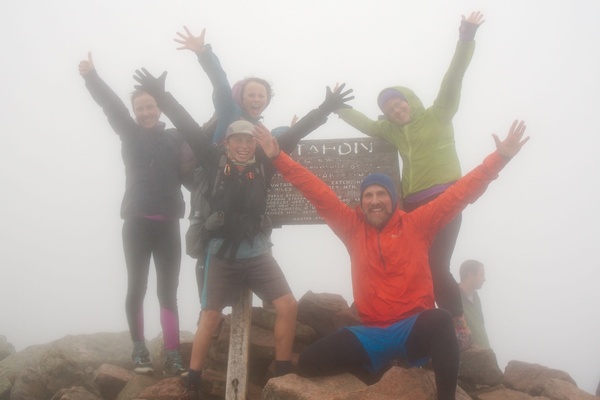
Never did I experience a crisis of identity, a feeling of brokenness to my core. Never did I think I wasn't cut out for living. Until the Appalachian Trail.
I'm not exactly a walking advertisement for the life-affirming aspects of thru-hiking. Though, in my case, this was the life-changing benefit of thru-hiking.
I experienced the very thing I had been intending to avoid. And how was I trying to avoid it? By making the best decisions. By identifying the right authorities and following them. My decisions were often counter-cultural ones but the motivation was the same. What or who is the authority here? Can I trust it? Will following provide security?
How one goes about setting up a life to cushion oneself from pain, failure, and brokenness is different for each person. This is where I love the wisdom of the Enneagram. Have you figured out your type yet?
The Enneagram shows us how the nine types try to cushion themselves, relying on protective beliefs and behaviors, so we don't have to acknowledge or come to terms with our core vulnerability. That weakness we each carry, like an Achilles heal. This is one way of understanding "personality", as a tool we use (unconsiously) to protect ourselves from being exposed.
But we are both/and, not either/or, and so along with our core weakness is a strength, or way of bringing light, truth, and restoration to the world, that can only be fully realized and released when we acknowledge and shine light on that "dark side" of self, on that chief weakness.
Here's my weakness, my Achilles heal.
I believe that if I can just identify and follow the right authority I will find security. The right authority will help me make the best decisions. And those decisions will spare me from pain.
I set out on my adult life path determined to make the best decisions, by aligning with the right authorities, the right way of thinking and living according to someone "out there" - teachers, parents, husband, experts, pastors, authors, etc. I was going to heed their advice (or not, there is a counter-authority streak in me) so that I could avoid suffering, if at all possible.
There is a very good side to this way of being in the world. We are the people who help foresee and mitigate disaster, literally we are worst case scenario geniuses. We are going to take care of people and resources, and set things up to reduce loss. We secure the perimeter.
This strong need for security can also manifest in really harmful and destructive ways. When I've looked at my dark side honestly and not flinched from the truth, I see the origins of fascism and fundamentalism, following a strong authority who will ensure security.
This is a real thing for people, a core need. And the culture we live in preys on this fear and insecurity for everything from consumerism to political affiliation.
Religions can also take advantage of this tendency with their hierarchies (patriarchy) and teachings that this set of behaviors, or statement of belief, will yield eternal security. Just follow the right authority and you'll be ok.
I find it interesting how different Types, which is to say different people, will pick up on the different underlying messages within culture, politics, and religion. Messages that are "broadcast" for everyone but that individuals respond to differently, based on their unique weakness and sin tendency (to use the language of the Enneagram).
My weakness, my sin, is to look for authority and security outside of God. And what gets so frickin' convoluted is that my tendency can be twisted and manipulated against me, in the name of God (the ultimate authority). Which is why I'm deeply grateful for my counter-authority streak, which I believe is there to protect me from this.
I operate instinctually from this mode: Who is the authority here? Can they be trusted? Can I heed their advice to find security?
My main modus operandi is safety, security, and comfort; and following (or not) the "authorities" to ensure that outcome.
If you have a similar personality to mine, your Achilles heal might be the same. If you are different, which you likely are, you will approach life from another angle, another perspective. Your weakness will lead you into different false-hoods.
You might seek meaning, purpose, and identity in helping people, seeking positive experiences, a quest for perfection or achievement, etc. to cover that vulnerablity or weakness, which is wrapped right up in your strength. We all have something.
At its core, The Reckoning, is reckoning with who you really are. The Reckoning is the awareness of how your tendency has shadowed all your decisions.
False-hoods have to be exposed, somehow, somewhere, in the course of your life in order for the other part, the pure essence of your core tendency, to have fuller expression.
And it needs to be expressed because that's your Divinely given strength for serving, loving, and contributing to all creation. All the good stuff is expressed and lived out in a more self-less way when we are aware of our weakness. And sometimes that awareness comes at a great cost to us, (and here's the kicker) and to those we love.
There is a natural order to human development; to aging, personal, and spiritual growth.
A big part of The Reckoning for me is realizing I'm not exempt from the natural order of growth and development. I'm not a special snowflake. I don't get to by-pass the necessary parts of the journey because I'm a good planner. It doesn't work that way.
We all need to break. I thought I could avoid a midlife crisis. And it turns out that the decisions I was making to sidestep that growth opportunity, initiated the very process. Oh, the irony!!
Maybe you don't need a big breaking in your life. Maybe you were already broken, God forbid, as a child (that's not the natural order). Maybe you've been broken many times and you're waving the white flag of surrender.
Something's gotta give, gotta fall apart at some point in your life so you can look at what you're really working with underneath all those layers of behaviors and beliefs you've used to insulate yourself.
Here are a few thoughts you might have in that breakdown.
How could I be so naive? Why was I so misdirected? Why couldn't I see this coming?
Maybe I was naive. The irony here is that we need a hefty dose of naivety (hope, and optimism) to get out of the gate, to engage in the messy, difficult, painful work of living.
Your lack of understanding is what enables you to actually take the risks necessary to grow up.
Marriage is a prime example of this. My twenty year old self was naive about the realities of a long-term, committed relationship. I had been given a good example to follow and foundation to build upon, but marriage, my marriage, has surprised me at many turns. I thought things about marriage then (roles, definitions, etc.) that I no longer hold to be true. You better believe I was misdirected.
In order to do the work of the first half of life we have to believe and act in certain ways. We need that structure and certainty to gain independence from our family of origin, to establish an identity, to face the world with a modicum of courage.
And yes, maybe you were misdirected, I know I was misdirected. I didn't know then what I know now, but what I did know and did believe, was the tool I had at the time.
We aren't given all the tools for the journey at the start of our adult life. We aren't given all the tools, at any point. We acquire them slowly, like digging up treasure with our bare and bloody knuckled, dirt-stained hands.
Don't disdain the tools you had at your disposal, at the time you had them. They were the right tool at the right time. They just aren't the right tools now.