Creating a Collaborative Learning Environment
September 20, 2013
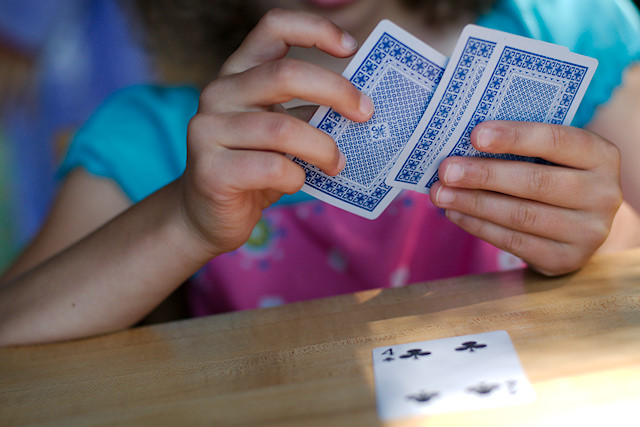
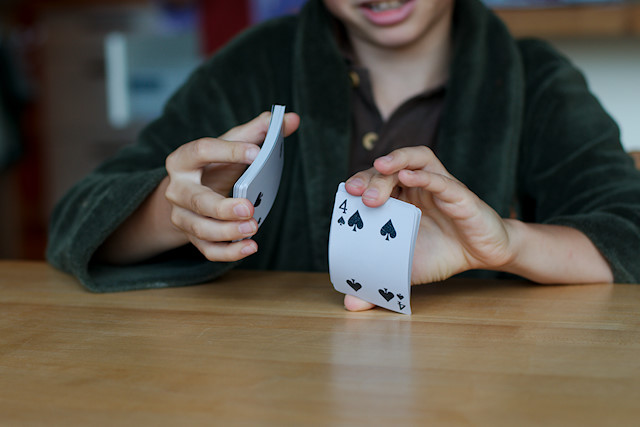
This past summer the kids and I got into the lovely habit of playing games together in the evenings, on a few lazy Sunday mornings, and on rainy afternoons. Tea and cards is a wonderful way to come together in the late afternoon.

Playing games together was an connecting activity that worked well regardless of who was home or who was at camp or away visiting Nana & Papa.
It was also an activity we shared with family who came to visit. We taught Papa how to play Wizard and played Apples to Apples (Junior Version) with the younger cousins, which was especially hilarious. Man those kids are good.
We learned a few new games, and enjoyed card classics like Hearts and Cribbage. Laurent's absolute favorite game is Chess but that's a two person game and his sisters have grown tired of it and I don't play at all so he will try to wrangle a game or two from any unsuspecting visitor.
Now that all our family members are competent readers we have more games at our disposal. When you play mostly card games that's not so much of an issue, which is one reason we've enjoyed playing them over the years.

Even so, we haven't let reading or reading difficulties get in the way of playing games. Through the years of non-reading children (at ages most children would "normally" be reading) we chose games with less reading, or we partnered readers with non-readers, and we also played video games with more audio visual components.
In short, we helped each other and we used resources that worked for us.
People have a tendency to get anxious when a child lags behind in "normal" development. There are valid reasons for this, no one wants their child left behind. We want to see our children succeed (ps. that's a link to a book you'll want to check out).
That natural anxiety response to learning delays, etc. will cause you seek out solutions and help for your child. This is good. But living in a state of anxiety about "delayed" development is not good.

Anxiety, that is rooted in fear, causes us to react in stress rather than supportive solutions.
We lose our creative thinking responses when we operate from fear.
One of the parental anxiety responses to any kind of perceived or real delay in a child's learning is to push a child "for their own sake". If we don't push them how will they eventually succeed on their own in the big bad world? Never mind the kid is seven and has a good 10 years or more before they have to prove themselves to the world-at-large.
What if, instead of pushing our children, we partnered with them?

At 12 1/2 Laurent has arrived at competent reader status. We've got a ways to go to strong reader status but we're making excellent progress. You can read more about Laurent's dyslexia here.
In the last couple years we have focused on teaching Laurent specific strategies for decoding language while continuing to help him read, the way we have since he was little.
We've helped him by reading things for him, accessing information and stories in a format that works for him, and encouraging him to read whatever he enjoys most - comics and graphic novels especially.
We collaborate with Laurent in his learning.
Education does not need to be competitive, it can be collaborative.
This fundamental belief and value is one of the many reasons we homeschool.
Once a child has a firm grounding in a collaborative and supportive learning environment, and feels firmly rooted in relationships of love and trust, I believe they are better equipped to deal with eventual non-collaborative learning environments (you know "the real world").
Helping non-readers, instead of pushing them, is just one example of collaborative learning. Here's more:
Pairing up for math practice.
Regular math practice is part of our elementary and middle years homeschool routine. Our youngest two have done their math together now for a couple years, literally together.
They shared the same computer-program workbook and progressed through the lessons together. I.e.: one login, one account, one progress report, etc for two students.
This was a win-win-win. It helped our non-reader with the reading aspects and helped our youngest since her older brother could explain things she couldn't understand. And it helped me since they were more motivated to do math together than on their own.
For the record, after a couple years of collaborating, our kids are now all on their own math tracks.
Could they have stood alone if removed from the home and placed in a classroom environment. Maybe? Probably? I don't really care.
They are children and I don't think they need to stand alone in their learning. That comes with time and when they get to a certain age they want to stand alone.
They want to prove themselves to the world, to prove they can do the work. This happens naturally if you just let it and if your children feel ownership over their learning.
Helping your kids spell.
I have a post in the works about spelling. I thought I might publish it before this one and could then link back to it. Nope. So here it is: If your children ask how to spell "....", just spell the words they can't.
Unless they don't care about actual spelling and prefer phonetic spelling. In which case, make sure to translate their work regularly so when they are more competent spellers (yes, it happens) and they look back on their early work, they'll actually be able to understand it.
They will enjoy reading their old writing but unless someone translates it you may not be able to decode it in the future. And obviously, make sure to translate the letters to grandma so she doesn't panic over the kid's "horrific homeschool spelling".

In a home rich with words, reading, and tools (like online dictionaries and spellcheck), eventually they'll learn to spell on their own and they won't want your help anymore.
In the case of children with reading and writing difficulties, such as dyslexia, I would recommend either learning spelling and language rules yourself and then teaching that in a way that works for your child or using a program together, studying spelling in a collaborative, non-stress environment.
Providing math cheat sheets.
At one time I thought I would teach the kids to memorize their multiplication tables by listening to a multiplication songs CD. This was when they were much younger and we actually still listened to CD's vs. downloads.
Problem was, I didn't feel like singing about math and I didn't want to fill up the car rides with "kids music", we prefer good audio books.

Instead I provided each child a 12x12 multiplication table which they've used for all their math multiplication problems, until they didn't need it anymore because... surprise, surprise they actually memorized it.
(And my son may never memorize it, but guess what? In the adult world we use calculators. He'd rather memorize his Taekwondo Poomsae.)
The real math learning we're trying to teach our children is not memorizing the multiplication table. The learning is in the particular concept being taught. Multiplication is just faster addition. It's a way to add up numbers quickly. So is using a calculator. Which is my preferred method of doing math and is a tool I use all the time. Why not give our kids tools too?
The irony of this is that just this week my youngest daughter, now 10, has decided to memorize her multiplication tables. Completely on her own initiative. "Quiz me mom." And instead of her usual story telling mumblings under her breath I hear the murmur of "4x4 is 16, 4x5 is 20..."
I told them they don't have to memorize it! How dare they go ahead and do it anyway!?

So many of us carry over conveyer belt hang-ups about learning - that it must be individual and measurable against peers "to count". That you must stand alone on your own merit to make it in this world. At a certain developmental stage, yes I agree. It's called adulthood.
Even then, we never stand alone but on the shoulders of our teachers and mentors. And in the very best situations, we partner in marriage, communities, and businesses because we realize working together is so much more effective and enjoyable than trying to do it all ourselves.
When learning is collaborative it's also confidence building. Because you feel support beneath you. It's safe. And when you feel safety you can go deep with ideas and interests and are mentally free for creative and intellectual exploration.
This is true for business, marriage, and education. This is true for life.
Why do we feel we must pull the safety net out from our children before they are ready?
Why do we push our learners instead of partnering with them?
Because we don't trust the process of self-directed learning. We don't trust that our children are wired to learn.
Partnering with our children does not mean doing the work of learning for them. That's their job, it's what they want to do, when they're in charge of it.

Partnering means removing the obstacles and barriers that are beyond our children's ability to scale themselves. Providing resources and tools. Teaching and inspiring. Exposing them to ideas and options they hadn't considered.
Partnering and collaborating with our children means just this: doing the work together until they are ready to do the work alone.