My Five Favorite Time Management Strategies
February 9, 2012
It's that time of the winter, at least it is for me, where I evaluate how things are working so far. I start the New Year all gung-ho with my home management and homeschooling. I've got plans and I've got a schedule and what can go wrong?
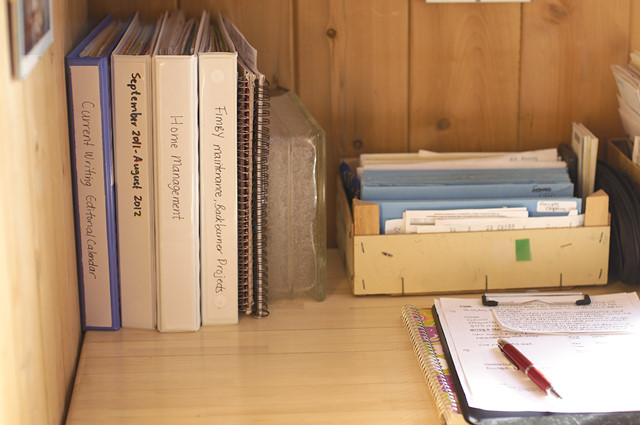
Oh, the little fact that we're human and humans don't operate in a vacuum of perfection. Plans will go awry, especially for us humans who are raising other humans. That's you mama.
Talk about imperfection, quirks and character challenges (not to mention the inherent fraility of the human condition - sickness, etc) in spades!
But that doesn't mean we shouldn't organize and plan, it just means we need strategies that work for us, not against us.
Today I'm sharing my five favorite time management strategies.
I've used these strategies through many different life stages. And in each season I tweak them to our needs but they've worked consistently for me, as long as I adapt them to my needs, not the other way around.
Strategy 1: Time Blocks
This is a very simple concept and I've noticed other homeschoolers also like to use this strategy for breaking up the day.
My current time blocks look like this.
- Early Morning 6:00-9:30 for me. This is my main e-mail, journaling, meditative type reading and writing time. Damien cooks breakfast, manages the kids. I eat while working.
- Morning 7:30-12:00 for the kids, 9:30 to 12:00 for me. Morning chores done by the kids. When I join at 9:30 I hit kitchen clean up and supervise and do school with the kids.
- Lunch 12:00-2:00 Kitchen work, cook and eat lunch. Lunch is a meal we eat together, round the table, usually a large salad. This is one of our coming together times in the day. Damien & kids do clean up and I'm usually back at my comuter checking my e-mail, doing blog work around 1:30.
- Afternoon 2:00-5:00 This is a long productive stretch of day but also has lots of room for margin, which is my fifth strategy (and very important). I try to wrap up computer work by 2:30. Some days I exercise. Sometimes I read. The kids do independent play, projects and outdoors. Or we do something together. I take care of homemaking tasks like meal planning, bill paying/finance stuff, online shopping, book finding (this is big right now). Some times I catch up on a computer project - like photo editing. Projects, outdoors, and homemaking is how I would describe this time.
- Supper 5:00-7:30 Supper prep and eating supper. While I start supper kids clean up the mess of the day and sweep. If cooking doesn't take as long I might do other stuff, usually related to feeding my family (meal planning, recipe finding). I try to get supper on the table at 6:30. We eat and talk - another big connecting time in our day.
- Evening 7:30-9:30 Until 8:00 I do my last computer stuff for the day while Damien and the kids clean up - usually photo editing and reading. Then I read to the kids, they read to me. I tuck the youngest two into bed, shower and go to bed myself by 9:30. I might read some more.
I've written about time blocks in another season of our life here.
What about...
- Cleaning - My household cleaning contribution takes 30 minutes a day, tops, in our tiny house (I love small scale living). I do my cleaning in the am, while schooling, or around meals. The kids tidy during morning chores and at the end of the day. Saturday morning we usually do a family clean up session after breakfast.
- Laundry - I do laundry when I'm in the kitchen around meal times. Kids fold and put away, whenever it needs to done. We do a maximum of five loads a week, usually less. Since we've moved and have so little floor space for rack drying we use the dryer (thankfully).
- Shopping - I don't do much of this. Damien buys all our clothes and gear. I make do or do without until I really need something. I shop online but do an errand run once every couple weeks for everything else. We often do this as a family since Damien has much more patience than me for shopping.
- Groceries - My thorn in my side and least favorite part of the week. Usually Wednesday morning. Wednesday afternoon is recovery (I explain that in margin).
- Weekends - Saturday for me is writing/professional work, family time, and kitchen work. Sunday is our day outdoors together. Our sabbath.

What I love about Time Blocks
The thing I like about using time blocks is I don't hyper schedule the activities or content within that time. Each block is set aside for a particular type of activities or activities but within that block there is freedom.
This is a very important concept for me - structure and freedom. I structure our days to allow for freedom. It seems a bit counterintuitive but it's really not.
Strategy 2: Structure Time, Not Content
I have been practicing this idea, as applied to home management and school, for awhile. But it wasn't until I read Leadership Education: The Phases of Learning that I had the language to describe my practice.
According to the DeMilles:
Great mentors help their students establish and follow a consistent schedule, but they do not micro-manage the content.
I think you can substitute homemaker for mentor. So in my case as a homemaker/homeschooler/writer I establish and follow a consistent schedule - our time blocks - but the content of those time blocks is open each week to our needs, inspiration and interests.
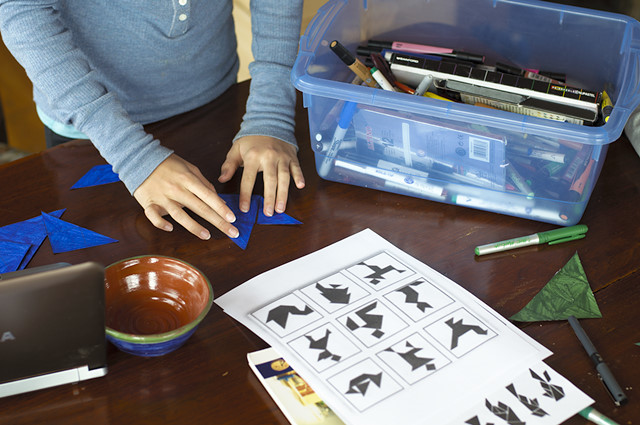
I need to do this to keep things fresh. I want to enjoy this journey as homemaker and homeschooler (these are golden years) and this principle has been key for me in cultivating joy and vitality, while still "getting things done".
This is the same reason I can't follow a curriculum to save my life, and my children aren't inspired to either - too much prescribed content.
Strategy 3: Anchoring
This is the technique I use for making sure those most important but sometimes easily neglected things get done.
I've written about anchoring at Simple Homeschool. To recap what I say there:
- Anchoring is simply attaching the most important tasks or those most difficult to do (sometimes these are one in the same) to the foundational pieces of our daily life: getting up, meals and bedtime.
- Anchoring is a great organizational tool to use in the beginning stages of turning a discipline into a habit.
- Our day has a certain structure that happens regardless of my mood or the weather. We get up, eat three meals and go to bed. All together that makes five cornerstones in our day. So I attach five prioritized activities to those cornerstones. Yours will vary depending on your natural strengths, interests, and circumstances.
So there's time blocks, the big blocks of time in the day, and then there's the cornerstones of the day that I anchor certain activities to that I don't want to drop the ball on.

Right now one of my anchoring activities is nighttime reading with the kids. When they were little we did that every morning but as they grown schedules shift and we find new times to make those priorities happen.
Another priority I'm anchoring is my morning routine. I get up consistently and anchor my quiet time to that rising (except for this morning when I got up late and got lost in e-mail). That works in this season of children who sleep well through the night.
One more example is family Bible reading or listening, a habit we anchor to our midday and evening meal. It doesn't happen with both meals but if we shoot for two, we'll probably manage one.
To apply this to your own life consider what is really important to you or a habit you are trying to establish, but is difficult to work into your day. Try to anchor it to a cornerstone - rising, eating or bedtime.
Strategy 4: The Calendars and Daily To-Do List
As I simplify my life I'm happy to say this area simplifies also. Not a lot goes on our monthly calendar, we're not running here and there and everywhere. But I do pencil in editorial deadlines, community events to consider and activities that aren't yet habits (like the recycling and garbage schedule).
I'm old school - paper and pen (I use Jessica's Organizing Life as Mom calendars). I look at this the beginning of my week and add the stuff I shouldn't forget to my weekly block calendar.
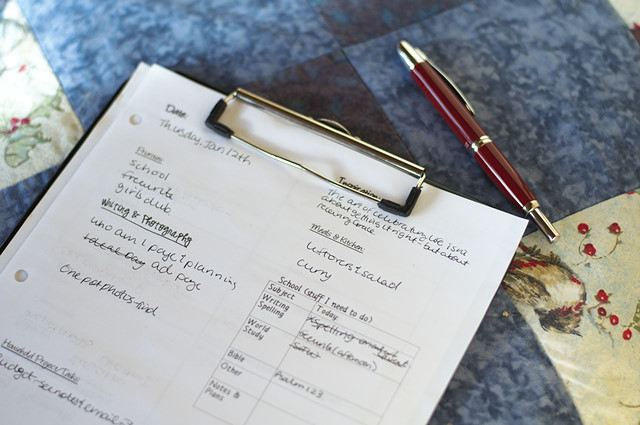
Download my weekly block calendar here.
With the weekly block calendar as my guide, I write a daily to-do list, inspired by Simple Mom's Daily Docket.
This daily to-do list master gets revised each season, depending on what I'm focusing on for school (this season it's writing). I have a school day master and a non-school day master for those weeks we are taking a break.
You can download both my school daily to-do and non-school daily to-do master lists.
These are intended to be used as a just a guide to help you make your own masters, if that's your thing. Everyone's needs are so unique so I think it works best to make your own.
If you want to use ready-made masters check out the resources offered by Life Your Way Printables or Organizing Life as Mom.
If this seems all so complicated (I'm an organizing gal, I love this kind of stuff) you could try Jamie's suggestion to make a list of just 6 things you need to do today. She talks about this in her book Mindset for Moms, which I will be reviewing here soon.
I think it's important to find a system that works for you and then be willing to tweak and change through each season.
My daily to-do lists might look complicated but they're really not. I might have one or two items under household - laundry, pay bills. The timeline is usually empty unless I have a plans outside the house - grocery shopping, library trip, girls club night, etc.
I choose three priorities for the day. Just three. A lot more than three things gets done but having only three must-do's feels good.
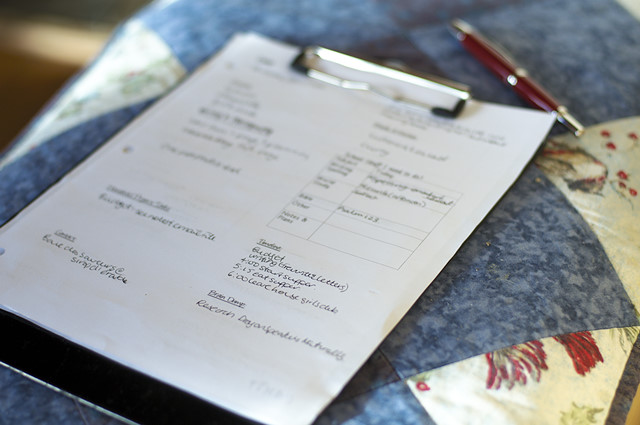
I use my daily to-do list as a tool. Not my master. There are days and even some weeks I go without writing a to-do list at all. Those are times I operate on auto-pilot. Because I use blocks to schedule time and anchoring to not miss the most important pieces, the days don't fall apart without a list. But I do love crossing things off a list - it's more mental than anything.
I never fill up the space in each category and there's a lot of white space for a reason.
Strategy 5: Margin
I worry that when I write about being organized I may appear super productive and to some extent I am. That's due to my personality and also a function of my childrens' ages.
So it might surprise you to know I need a lot of downtime. I need time to read. I need time in nature. I need time to sit on the couch with my husband and chat. I need time for something else with my husband. I need sleep.
And although I'm on the extroverted side of the spectrum, because of the giving out I do as mother, I'm actually just barely past that middle line between introvert and extrovert. I love interacting, talking, chatting and then I need downtime to recharge. Especially after having people over to visit, or after a morning running errands etc.
Some of this downtime is scheduled and some of it I simply leave room for in my planning as margin.

Scheduled downtime includes afternoon exercise or nature walks, our one day a week family outdoor practice, or an afternoon of chill after a morning of grocery shopping.
This latest one I started recently after consistently "reaching my max" by mid-afternoon on grocery shopping days. So now my afternoon schedule after a morning of grocery shopping is very light. I am so drained when I come home - shopping on a budget (blowing the budget), price comparing, reading and learning French, not finding what I want, making shopping substitutions, unpacking groceries, finding creative storage space for everything in our small kitchen, etc.
I need time to recharge and refill. I'm learning to give that to myself. For my sake and my family's.
I plan for margin every day. This simply means not filling every moment with something "productive". It means being realistic about my own limitations and this job of mothering. With little ones your margin needs to be even bigger since everything takes so much more time.
My mornings are super-productive - writing and homeschooling. My brain is at its peak and I'm energized and ready to go strong. Maybe it's my one cup of coffee that does that?
But after a morning of high output I need pockets of downtime in my afternoon. Some people call it self care but since I practice self care in my mornings also - eating well, etc. I consider my afternoon pockets of downtime something different.
I don't schedule these activities, I prefer to schedule time, not content, but I simply leave time in my day for these activities to happen if I need them.
These include personal reading, a power nap, a hot bath, afternoon tea. Or I might do something easy-on-the-brain with the kids - a game of Uno, sitting on the couch listening to an audio book together or reading together.
This is not the extent of my afternoon. I have work I do also but I leave room for margin. I plan for margin in the morning also for the kids as they transition between different lesson and practices.
The point is - it's not all go-go-go. I can't operate in joy and wellness with that kind of schedule.

I'm a productive person but I don't like the huge emphasis in our society on productivity and efficiency. There's a certain anti-human bias to that way of thinking.
Having watched my children grow and flourish in the spaces of time I've created for them I see how important that is in my own life. And I'm willing to make compromises and let go of certain expectations to give myself that same freedom.
I love being organized and getting stuff done. I love living in joy and freedom. The two can exist side by side.
More Getting Organized posts:
- Resources to Help You Get Organized
- Weekly Blocks ~ A Planning Tool
- Homemaking & Homeschooling
- Defining Priorities to Make A Family Schedule