Transition to Scholar with Project-Based Learning ~ Hello High School
September 27, 2013
Last winter, Céline's education took a turn. She expressed her desire to steer her own ship and with some trepidation I agreed.
"But Renee," you may ask. "I thought you were interest-led learners, don't you want your kids to steer their own ship?"
Absolutely. But when your child steers her ship in a direction you had never conceived it does test your resolve.
Last winter Céline told us she wanted to simplify her studies around one main theme - Role Playing Games (RPGs). Having spread the table with many ideas and options the previous fall, this was what fascinated and captivated her the most. Something not even a part of my carefully constructed curriculum.
Looking back I'm not sure why I was so surprised. In her previous fall assessment I recorded this interest of hers. And my specific aim for the coming school year was to "use this interest" to inspire the growth of some skills and aptitudes that needed development, e.g., writing.
The development of Céline's writing skills did come about by the way, in a most unexpected and delightful way, as related to her interest in RPGs.
Céline met a group of teens online who share her love for role playing games. As a group, they create characters and write stories together. Céline now engages in this peer-supported creative writing on a regular basis. Writing ~ Check.
As an interest-led homeschooling parent my objective is that our young adult children will take responsibility for their education in their scholar years. It's what we've been working towards all these years.
How do we do work towards this aim? By giving our young children lots of freedom to play and discover the passions and interests that will light their fire and ultimately motivate them to work hard.
We fan the flame within instead of lighting a fire beneath.
But I was definitely a bit hung-up on a preconceived notion of what scholar stage pursuits might look like. Céline has studied many interests over the years that would fit such a description, something easily labelled as "scholarly".
Those subjects and ideas were easy for me to fit into a scholar mold. "Games" were not. I lacked the imagination to see the potential. But only for short, short while.
I am sold on interest-led learning. On learners having freedom and responsibility, and I wasn't going to let my little hang-ups about what counted as studies and what didn't get in the way of my daughter's passions.
So last winter and spring, Damien and I dived in and partnered with Céline to guide this study.
The best way Damien and I could conceive of guiding our daughter in an RPG based curriculum was with a project. A project arising from her interests and her vision. This was not a parent assignment. This was complete learner-directed project work.
Project-Based learning
In the early years of homeschooling I loved the ideas of unit studies. This was a method of learning that appeared to bring together separate subjects into a whole. And I wanted to encourage this in our homeschool.
In reality, in our home at least, unit studies were simply a lot of work for me (even when you followed a pre-made study) and were problematic when the learner's interest tracked somewhere else.
Our children have always engaged in project-based learning. I just didn't have the language for it until about four years ago, when Céline hit her middle years.
We were still figuring out our way with project-based learning back then. We experimented a bit with parent-directed projects, which we found to be ineffective in achieving our objective. Which was to have our student own her learning and move forward on her own initiative.
What does project-based learning look like in our house?
When our kids were young it looked like intense play, that arose from interests or obsessions. Projects in those days were as "simple" as building a lego house, or completing a drawing. We didn't have the language then to call it "projects" it was simply play, crafts, activities, etc.
Most of my children's early self-directed projects were crafts involving lots of paper towel tubes and masking tape. And when they were exposed to Rube Goldberg machines, well then there were domino and marble contraptions set up all over the living room.
There was a long period of time where making miniatures, along with dollhouses and castles, was an on-going project. The kids did a huge amount of research, reading, and problem solving in making those toys.
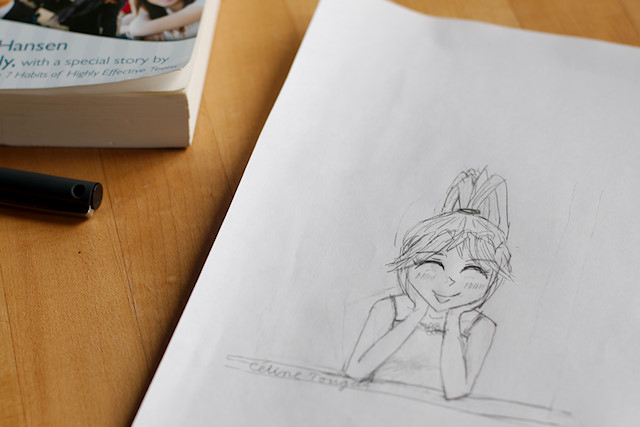
There was the pond Laurent built in our backyard and girls' gardens. And always many sewing projects.
I remember a couple years ago when the kids published a newspaper over the course of a few weeks. I still have it, of course. Articles were written with a featured story on the (fictional) feral cat population of Lunenburg county. Ads were created for products. A title was chosen, etc. It was published and read by the household to much acclaim and fanfare.
I've just pulled a few small examples from the recesses of my memory. If I looked through our portfolios I could name project after project our students' have accomplished.
I believe children will engage in project-learning, without needing a lot of direction from adults, if they are allowed and encouraged to do this.
Projects are a normal life occurrence in most every home - renovating the bathroom, planning and taking a trip, organizing a Christmas party - these are projects. People do them all the time.
However, even though kids can conceive and follow-through projects on their own, support from parents is crucial. Support is:
- Giving children time for their projects.
- Giving them space in the home. (We've never had separate project or studio space, we simply allow our children to live in our living room.)
- Observing their interests and providing project suggestions.
- Gathering resources and materials beyond your children's means. We want to encourage our children to be resourceful but they will be limited by what they are exposed to. So expose them to good stuff and have the supplies they need for open-ended discovery.
- Finding mentors when the projects go beyond your knowledge and expertise.
- and more...
Project-based learning happens all the time in our home. I have projects, Damien has projects, each of our kids is always working on a project, or two.
Projects, as a homeschool method, became more front and center in our homeschool when Damien started working at home and was therefore more active in homeschool life.
Coming as he did, from the real working world (vs. the homeschool world of curriculum fairs), project-based learning makes total sense to Damien.
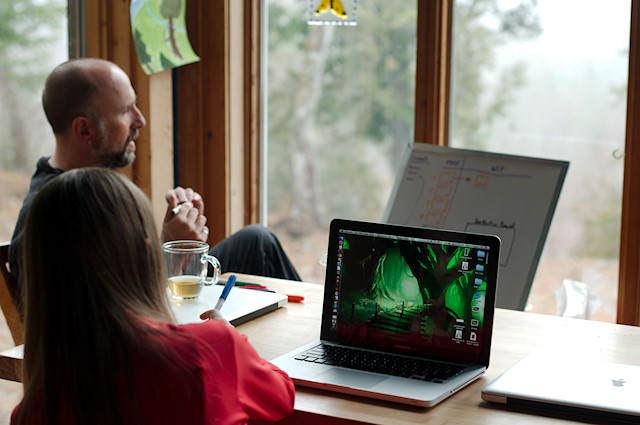
Work in the real world is largely project-based. It is not "school subject" based. You don't do geography projects in the real world. You take a road trip. You don't do English projects. You start a blog. You don't do science projects. You plant a garden. You don't do math projects. You renovate the bathroom.
And so, when Damien became more involved in our homeschool, bringing his "real world working experience" with him, projects became a cornerstone piece of the homeschool puzzle.
Project-based learning for our scholar
Whereas our younger students move in and out of projects, depending on the day and their whims (the privilege of childhood), Céline is engaged in project-based learning on a near daily basis (the responsibility of young adulthood). A responsibility she is ready and willing to accept. Laurent is surprisingly close to this reality also.
Our role as parents in this process is to provide: structure, guidance, accountability, resources, collaboration and connections.
We help our daughter structure her day to meet her goals. We do this by structuring our home life to support her learning and everyone's learning.
We provide guidance and accountability with regular meetings where we check in on her progress and briefly record what's been going on. (The project itself is the evidence of the learning. I like to keep notes along the way, because that's just what I do. I'm the meeting secretary, you could say.)
We provide resources beyond our daughter's means but not too much. She needs to learn how to find and secure resources.
We collaborate with our daughter in overcoming obstacles and barriers. Our meetings are mostly to answer the questions: Where are you stuck? And, how can we help?
We help our daughter make the connections she needs to move forward; finding mentors, lessons, classes, etc. to meet her needs.
Céline's last winter and spring school term was as much about figuring out how to manage independent project-based learning, as it was the project itself (which is still ongoing).

This is not school-at-home. And I have very few in-real-life models to look to. None of my old homeschool mentors from back when I actually knew local homeschoolers, homeschooled this way. Or if they did, it wasn't evident to me at the time.
High school was the stage when homeschoolers took classes at the local high school, completed at-home courses that looked very "schooly" and could easily be quantified as history, writing, math, science, or enrolled in high school completely.
Lori Pickert's book Project-Based Homeschooling and blog has been a helpful place to glean ideas and find encouragement for this learning method. I highly recommend it. But even with books at hand, we still have to find our own way. Figuring out processes and systems that will be unique to our family.
Project-based learning as one piece of the whole picture
A funny thing happened when we let our daughter dive head-long into a project which, on the surface, seems rather non-academic. Role playing games?
Two interesting things happened actually.
First, the academic subjects (those things that post-secondary institutions and nosey neighbors want to know you've studied) like history, foreign language, mathematics, and design started to show themselves through this project. Along with study skills such as research, time management, note taking, organizing information, project development, collaboration, etc.
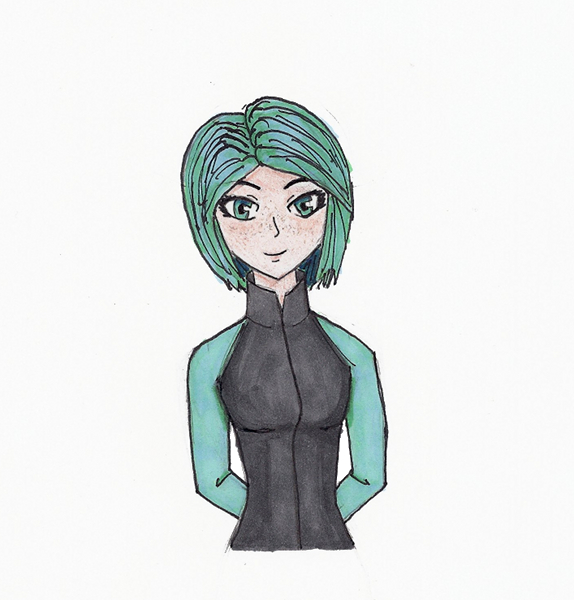
The second interesting outcome took a bit longer to develop, as these things do. We gave our daughter all the time she wanted to pursue this project. We didn't say "this project" and .... We gave her total freedom for just the project and we muddled our way through supporting that endeavor.
During that time our daughter did a lot of online reading, a lot of drawing, a lot of "playing around" with computer graphic applications.
She took a break over summer and when our school routine started again - a regular daily schedule for learning - things exploded. There are simply not enough hours in the day for Céline to study and learn all the things she wants to do. What a wonderful way to live!
The project opened up a doorway for Céline to Japanese culture, and she's officially become a Japanophile. She wants to learn Japanese, the language (currently studying Hirgana).

She found an online course, she practices every day, she is starting, just starting, to sound out Japanese character words in her favorite Manga.
Céline is in the "fascinated by dystopian worlds phase" of young adulthood. "Mom, have you heard of the book "Nineteen Eighty-Four"?" She's finding books, ordering them, reading.
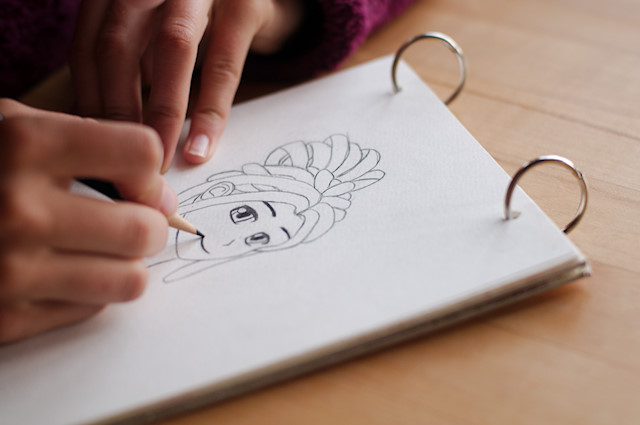
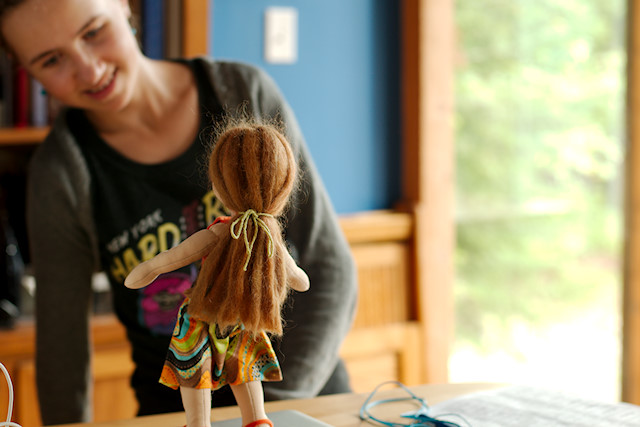
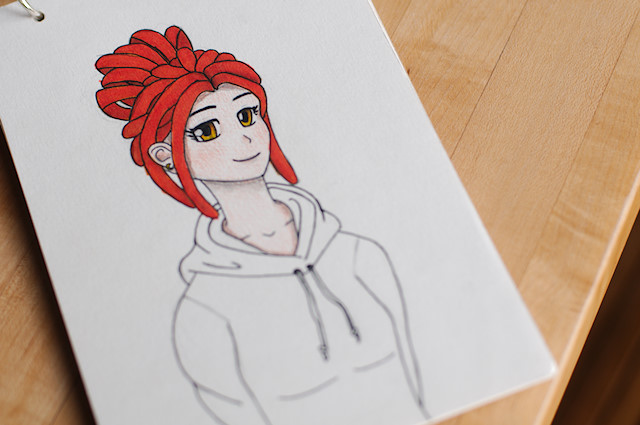
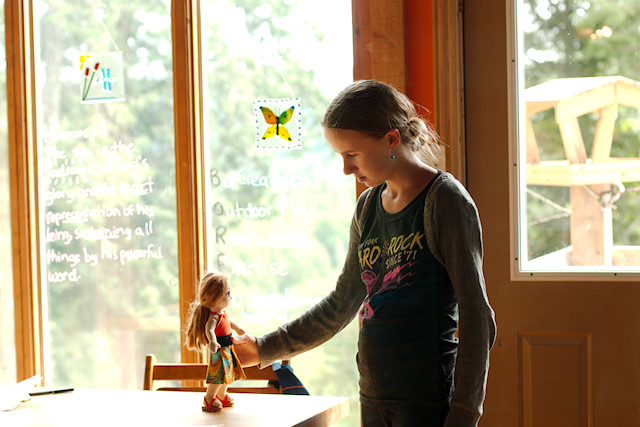
She's sewing every spare minute she has, making dolls of course. This latest one with a Japanese girl school uniform. She's drawing Manga-inspired characters for the gaming she does with her friends online. Beautiful drawings, she's so pleased with herself.
She joins her brother and sister for grammar, loves to be quizzed especially, anxious to prove she knows this stuff (which I've never taught her).
Céline is working to finish pre-algebra. The last math we require our students to study. Higher math will be her call entirely.
In the evenings, we all watch Canada: A People's History together. The four of us together again in our studies. And I hear her chuckling from her study corner, while I read stories to her brother and sister. You can't help being drawn into a good story.
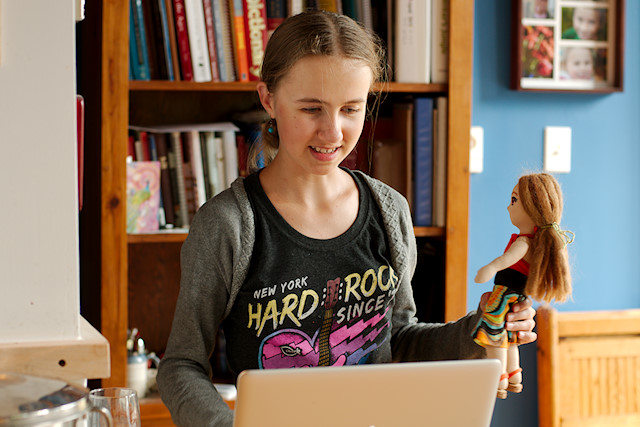
The project is there. It simmers in her mind and she works on it regularly. We meet, we discuss, and she does the work she wants to do to move it forward.
And when she's not working on the project she is taking Japanese lessons, writing stories online, creating characters for those stories, sewing, cooking supper once a week, taking Taekwondo lessons, reading books, watching sci-fi movies with her Dad, reading online, going for walks with her family, talking about starting a blog, running on the weekends, learning some more programming from her Dad, and mixing the music on Spotify.
Hello high school.
My scholar. My teenager. Could learning be more lovely than this?
Our home is filled with young adult vigor (the late nights!), enthusiasm, concentrated study, knowledge bursting-at-the-seams, determination, and lots of good humor (and loud rock music whenever I agree to it).
And I am in love, all over again. In love with my beautiful daughter, coming into her own. In love with homeschooling. In love with interest-led learning. In love with our home life that supports our children in their growth. In love with my husband who supports this endeavor right by my side. In love with my life.
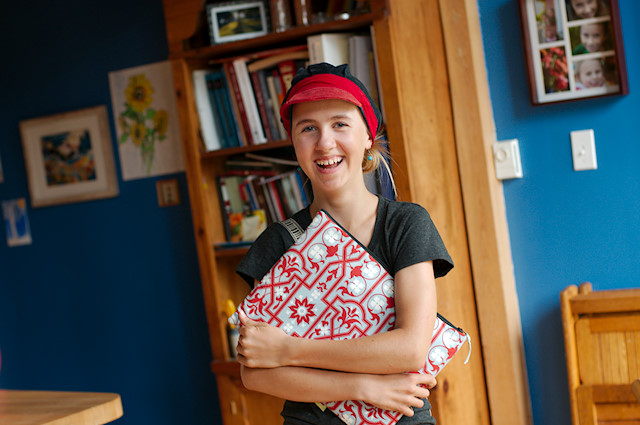
This is what interest-led learning looks like. It looks like love.
Yes, I am a sappy sentimentalist (grounded in the reality of the experience) when it comes to interest-led learning. It's beautiful and I will continue to share that beauty and joy, with my whole heart.
I'd like to share my thoughts about what Céline's high school years might look like and how (or if?) that will translate to post-secondary preparation and studies. But that's obviously another post or two in the making.
This post published with permission and editorial feedback and corrections from Céline.
Project-Based Learning and Interview Assessments is a follow-up to this post.